
Newton’s First Law of Motion states that every object remains at rest in a straight line unless it change its state because of a external force. Hall of Fame pitcher Nolan Ryan recorded 5,714 strikeouts, using the first law of motion when throwing his fastball. Ryan held his baseball in his glove as he looked at the catcher’s signs. After getting a sign, he went into his windup and throw the ball in motion toward home plate with an overhand delivery.
In addition to Ryan’s ability to throw a fastball at 100 mph, he knew very well the physics of air pressure acting on the surface of a spinning ball. This would be putting lateral spin on his fastball causing the ball to move several inches sideways as it crossed home plate, making it almost impossible to be a hit by a hitter. Very good pitchers use the first law of motion to throw fastballs, sliders and also curve balls.
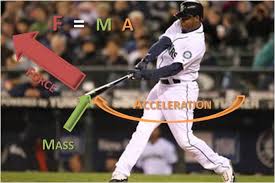
Newton’s first law is realized at both ends of a pitch. When the pitcher sends the baseball in motion and the hitter sets the bat in motion by swinging. Newton’s Second Law of Motion shows the velocity of a mass object changes when it is projected to an external force. This second law shows the force generated when there is contact is equal to the combined mass and acceleration of both the ball and bat.
Newton’s second law is illustrated when a batter bunts, because the mass of the bat is not in motion. The mass acceleration is provided by the pitched baseball. A very smart bunter uses the mass and acceleration factors at the moment of contact by allowing the barrel of the bat to react slightly to the force generated by the baseball, in other words allowing the bat to hit the baseball without putting any force to the ball. The result is a bunt that rolls to a stop short of an infielder.
Newton’s Third Law of Motion says that for every action there is an equal and/or opposite reaction. Outfielders understand this in terms of a baseball that goes up must come down. Exceptional outfielders have the ability and talent to make calculations as the baseball begins rising when hit. An outfielder might recognize the distance between his location and the projected landing of the ball in order to catch certain balls on the fly.
Reference:
“Newton’s Laws.” Physics of Baseball, forceandmotionbaseball.weebly.com/newtons-laws.html.
 Mr. Jose The Scientific