
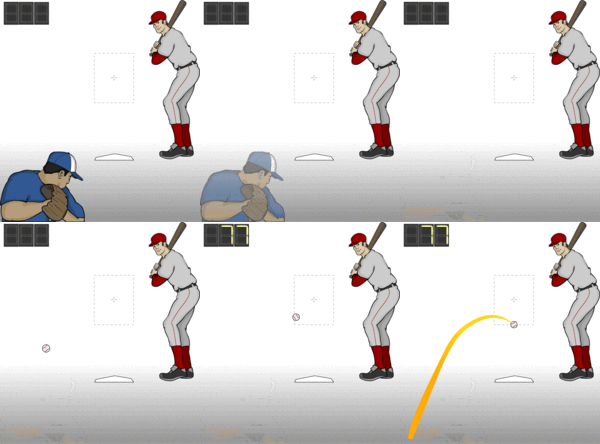
https://en.wikipedia.org/wiki/Curveball
The same principle that allow curveballs to curve also allow airplanes to fly. This is proven by something called Bernoulli’s principle: Airplane wings are designed to be curved on top, which creates an imbalance of air pressure on either side of the wing, resulting in lift.
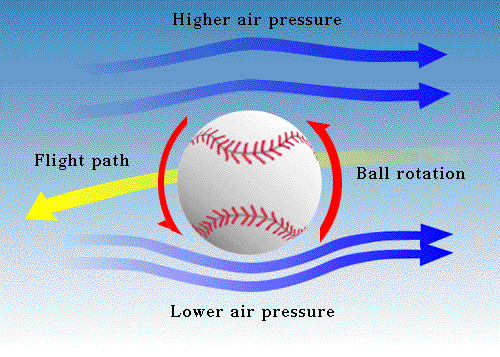
When pitching a curveball, the pitcher puts a spin on the ball when releasing it from his hand. As it travels through the air, the spin causes the ball to disturb the air around it.
However, the spin causes air on one side of the ball to move faster than the other, resulting in uneven pressure on the ball, making it curve. A related scientific principle, the Magnus Effect, forces the spinning ball to move in the direction of lower pressure. Then, the baseball’s raised seams help guide the ball by creating airflow resistance.
The amount of break on the ball depends on how hard the pitcher can snap the throw off, or how much forward spin can be put on the ball. The harder the snap, the more the pitch will break. Curveballs primarily break downwards, but can also break toward the pitcher’s off hand to varying degrees. Unlike the fastball, the height of the ball’s flight path arc does not necessarily need to occur at the pitcher’s release point, and often peaks shortly afterwards. Curveballs are thrown with considerably less velocity than fastballs, because of both the unnatural delivery of the ball and the general rule that pitches thrown with less velocity will break more.
An excellent explanation is given in “The New York Times Book of Science Literacy.” “The ordinary curveball, breaking to the left or the right, relies on a lateral force caused by its rapid spin. The sideways spin lowers the pressure on one side and raises it on the other. The effect of spin is potent. A ball spinning at 1,800 revolutions per minute a ball that will turn about 15 times in its 60-foot, 6-inch journey to the plate will feel a sideways force of more than an ounce, which will turn its path by about one and a half feet.”
So, a curveball curves because the pitcher has enough skill to use scientific principles for his own benefit.
Reference:
“Curveball Science.” Astrocamp School, 29 Aug. 2016, astrocampschool.org/curveball/.

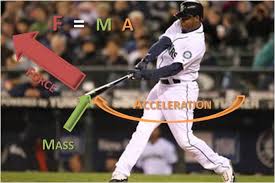


 Mr. Jose The Scientific